Modern automotive lighting is no longer limited to a purely functional role. LED logos, illuminated grilles, and dynamic light animations are becoming a new communication language for car brands. How does the combination of design and technology turn light into a recognizable brand signature?

Just a few years ago, lighting in cars had an almost exclusively functional role – it provided visibility for the driver and improved safety. Today, it has evolved into a much more sophisticated role. LEDs, OLEDs and micro-LEDs open up completely new possibilities for designers, and light is becoming one of the most important elements of brand identity. More and more often, we can recognise vehicles not only by their body lines, but also by their distinctive ‘lighting signature’, which makes them recognisable from a long distance.
In this article, we explore:
The development of lighting technology is one of the most dynamic changes taking place in the automotive industry. The path has led from simple halogens, through xenons, to LEDs, which currently dominate the market. The next step is OLEDs and micro-LEDs, which enable the creation of very thin, light and flexible light sources. Examples of such innovations are our projects, including an advanced prototype of OLED lighting.
In addition to its key importance for safety, lighting has also become important as an expression of creative design. This is a natural development of the broader trends we described in the article: Designing the automotive lighting of the future: trends, challenges, and opportunities.
What seemed extravagant not so long ago is slowly becoming the norm today. Illuminated logos, illuminated front grilles, and illuminated door sills and illuminated boot trim are appearing in an increasing number of models – from premium brands to electric car manufacturers, for whom the ‘wow’ effect is an important element of communication with customers. Here, light is more than decoration – it has become a new design language.

Today, exterior lighting elements shape the user experience, complementing the ambient lighting used in the interior. The welcome effect, smooth colour transitions and visual signals informing about the vehicle’s status (e.g. EV charging status indicated by the colour of the logo) allow the car to communicate with its surroundings in an intuitive way. This seamless blend of design and functionality brings the automotive industry closer to the world of consumer electronics.
However, the implementation of decorative LED lighting requires addressing a number of challenges.. Engineers must fit the installations into a limited construction space and ensure their durability in conditions of humidity, high temperatures or the impact of road salt. A good example of this approach is our design for an innovative rear lighting variant, in which we have combined design requirements with stringent reliability standards.
Legal issues are also important – regulations regarding brightness, colours and lighting methods vary from region to region, and some light animations require homologation. You can learn more about combining safety with visual appearance in the article: Design and safety – the design of automotive lighting.
Energy efficiency is another challenge: in electric vehicles, every additional feature affects the range.
Manufacturers are also increasingly emphasising the ecological dimension of modern lighting. LEDs consume significantly less energy than traditional light sources, and the development of OLEDs and micro-LEDs further reduces the weight of components and their energy requirements. The use of recycled materials in the production of luminaires and diffusers is growing. As a result, decorative lighting not only enhances the attractiveness of the car, but also supports the sustainable development strategy of OEMs.
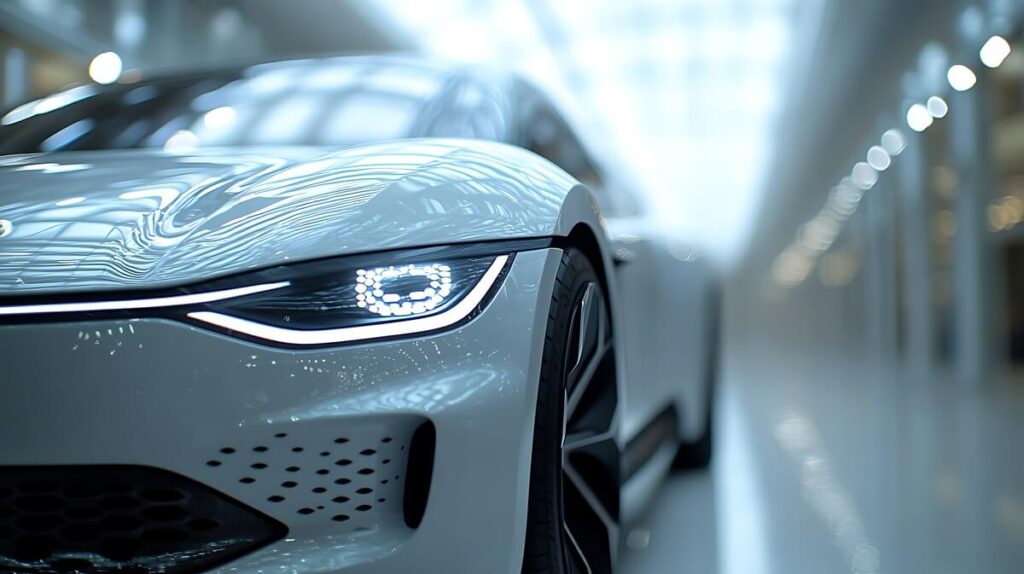
The coming years will bring even greater opportunities for personalisation. The colour and intensity of the light, as well as the animations created with it, will be able to change depending on the driving mode or the driver’s preferences. Interactive solutions will emerge, such as lighting that communicates with other road users as part of V2X systems. Attempts to standardise light animations can also be expected, which will prove particularly important in the context of autonomous mobility – light will become a universal language between the vehicle and its surroundings.
Decorative LEDs in the automotive industry are more than just a design accessory. They are a strategic tool for building brand recognition, shaping emotions and communicating with the user. This trend is not slowing down – on the contrary, it is entering a new phase of development with OLEDs and micro-LEDs. For manufacturers, this means combining design creativity with rigorous technical standards, and for customers, it means a completely new experience of interacting with their car.
At Endego, we support manufacturers in the design and implementation of modern lighting solutions – from design concepts and simulations to software development. You can learn more about our projects from case studies such as:
If you are interested in innovative solutions in the field of automotive lighting, please contact us. Together, we can create solutions that combine design, technology and reliability.
The past few years have been challenging for the European automotive sector – production declines, supply chain disruptions, and intensifying competition from Asian manufacturers have forced many companies to downsize. Now, as the market slowly begins to recover, businesses face a new challenge: how to quickly restore their delivery capacity when skilled specialists are in short supply?
Read moreA few decades ago, securing a car meant a sturdy lock and an alarm. Today, it means defending a rolling, always-connected computing platform – equipped with dozens of Electronic Control Units (ECUs), multiple in-vehicle networks, and high-speed links to the cloud.
Read more