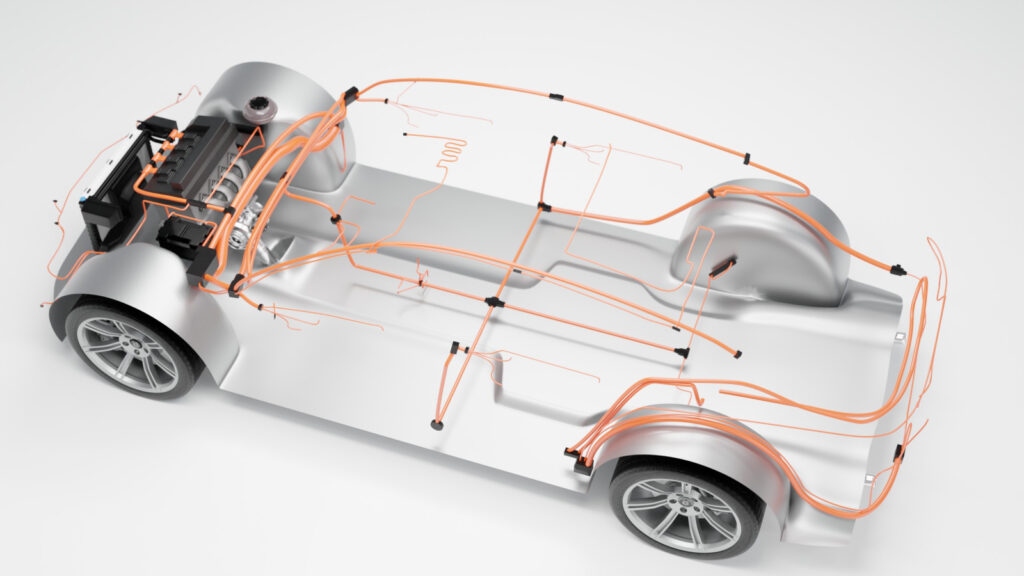
While most automotive systems get the spotlight – engines, batteries, infotainment – it’s the humble wiring harness that truly connects them all. In an age of electrification, autonomy, and high-speed data, wiring harnesses are becoming more complex and mission-critical than ever.

The global wiring harness market is expanding rapidly to support rising vehicle electrification and digitalisation. In 2025, the market is estimated to be between USD 67 billion and USD 90 billion, driven by advanced driver-assistance systems (ADAS), infotainment, and high-voltage electric vehicle systems. Analysts expect it to double by 2035, growing at a compound annual growth rate (CAGR) of 6 – 7%.
Asia-Pacific leads the deployment of harness systems, representing nearly 48% of the market in 2024, while the HVAC and high-voltage segments are growing fastest, with a CAGR of 11%, reflecting their importance in EV architectures.
Harness design is far from simple. Engineers must balance:
AI is making its mark – now helping optimise harness routing, reduce weight, and automate connector placement. Robotics and vision systems are even planning for automated connector mating, a breakthrough in reducing manual assembly errors.
From the definition provided on our Wiring Harness Competence page, Endego brings deep, real-world expertise in designing and implementing wiring harness systems:
These services are offered through flexible delivery models, including Talent-as-a-Service (TaaS), Solution Delivery, and Build-Operate-Transfer (BOT), ensuring alignment with client team structures, development timelines, and scalability needs.
The wiring harness is the invisible backbone of every vehicle’s electrical system. As software-defined architectures, electrification, and connectivity transform mobility, wiring design is gaining the engineering spotlight.
Endego’s blend of deep architecture skills, engineering precision, and development flexibility empowers OEMs and Tier-1 suppliers to deliver harness systems that meet tomorrow’s performance, safety, and cost requirements.
Sources:
The past few years have been challenging for the European automotive sector – production declines, supply chain disruptions, and intensifying competition from Asian manufacturers have forced many companies to downsize. Now, as the market slowly begins to recover, businesses face a new challenge: how to quickly restore their delivery capacity when skilled specialists are in short supply?
Read moreModern automotive lighting is no longer limited to a purely functional role. LED logos, illuminated grilles, and dynamic light animations are becoming a new communication language for car brands. How does the combination of design and technology turn light into a recognizable brand signature?
Read moreA few decades ago, securing a car meant a sturdy lock and an alarm. Today, it means defending a rolling, always-connected computing platform – equipped with dozens of Electronic Control Units (ECUs), multiple in-vehicle networks, and high-speed links to the cloud.
Read more