The automotive industry is a highly demanding market. It shows especially in areas of quality and project risk. Every company faces difficulties achieving high standards, avoiding unnecessary risk and complicated issues before their product gets to an end user. Various standards and guidelines help address these issues. ASPICE is the best-known example of such.

ASPICE (or Automotive SPICE) is the main framework and standard to determine a proper product development structure. It was developed near the end of 1990 by German companies such as BWM, BOSCH, Continental, Daimler, and Volkswagen. In the beginning, it addressed mainly fields related to software and system engineering. However, the new revisions apply also to mechanical, hardware, and overall engineering areas. Nowadays, ASPICE has much broader usage in process improvement in the automotive sector than it used to. It serves as a process assessment tool for OEMs, giving an insight into the quality of product development of a supplier. Today, we will skip the part related to the assessment process and focus mainly on how ASPICE could be a guide to improve the everyday work of a company.
Take a look at the overview graph with the V-model used in ASPICE:
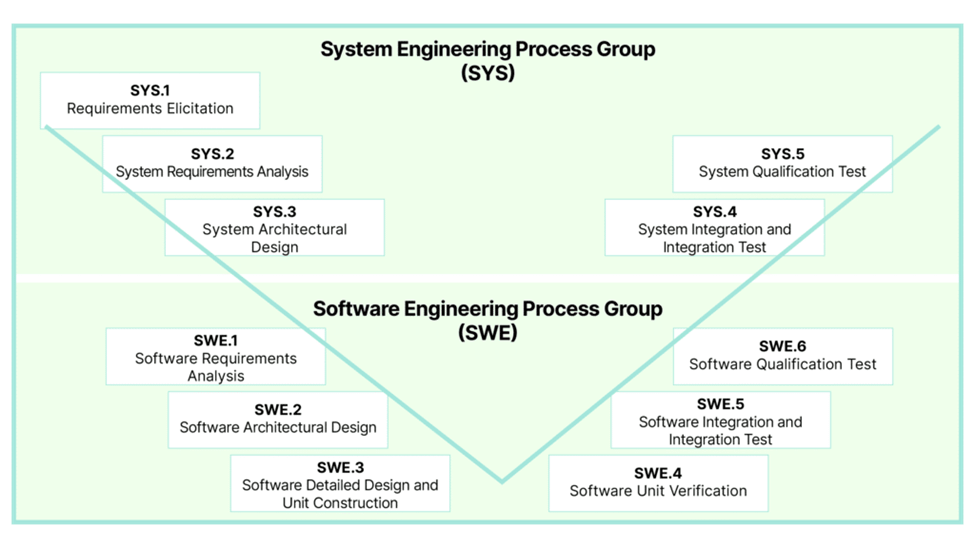
You will see that the above process steps are V-shaped. It is from where the V-model took its name. The main areas described here are System Engineering and Software Engineering. However, new revisions of the ASPICE also address other parts of the process.
In general, product development starts from the top left corner step SYS1 and goes down through other steps. You can separate three main sections of the V-letter:
It’s a general V-Model overview. However, ASPICE has more steps worth describing:
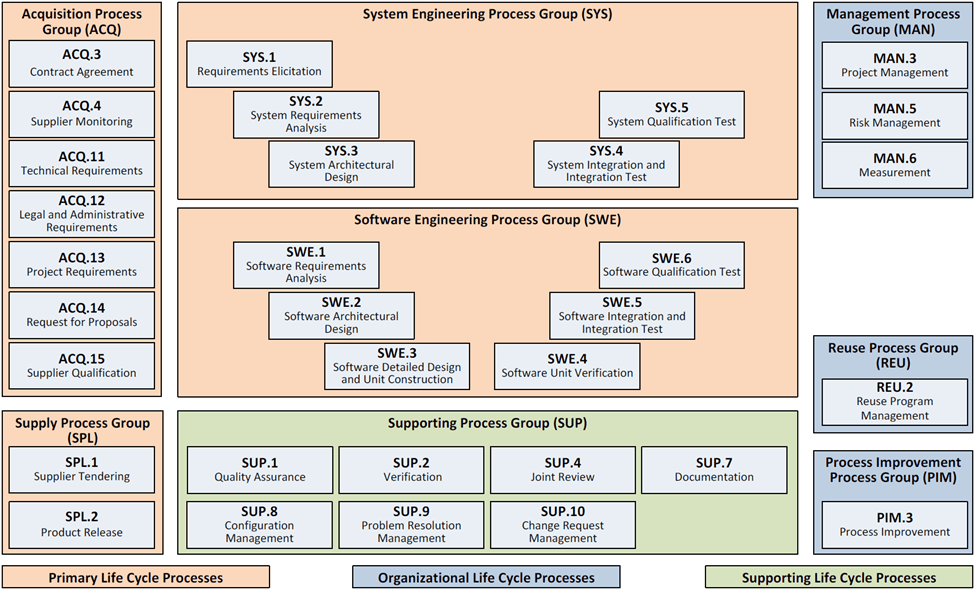
The above overview comes from the ASPICE v3.1 revision of the guideline document. You can see that ASPICE addresses various processes during the product life cycle. It aims to support product development and provide clues how to report, verify, and improve the information flow.
There are several benefits to introducing an ASPICE way into your product development:
Although ASPICE is a highly functional framework in the automotive industry, it is not challenges-free. Applying this framework connects with challenges, especially at the beginning, such as:
If you would like to find out more about ASPICE, I suggest looking for free guideline documents and a pocket guide that can help you understand each process step. Next time, I will try to explain how to use ASPICE to assess processes during the product life cycle.
The past few years have been challenging for the European automotive sector – production declines, supply chain disruptions, and intensifying competition from Asian manufacturers have forced many companies to downsize. Now, as the market slowly begins to recover, businesses face a new challenge: how to quickly restore their delivery capacity when skilled specialists are in short supply?
Read moreModern automotive lighting is no longer limited to a purely functional role. LED logos, illuminated grilles, and dynamic light animations are becoming a new communication language for car brands. How does the combination of design and technology turn light into a recognizable brand signature?
Read moreA few decades ago, securing a car meant a sturdy lock and an alarm. Today, it means defending a rolling, always-connected computing platform – equipped with dozens of Electronic Control Units (ECUs), multiple in-vehicle networks, and high-speed links to the cloud.
Read more